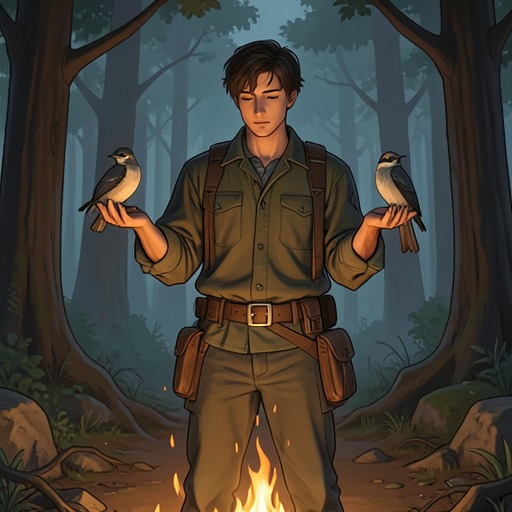
Bird catchers and birds
The Painted BirdThe Bird catchers and birds metaphor gives The Painted Bird a language for a world divided between those who hunt and those who are hunted. Readers who recognized that division in their own lives found in the boy’s struggle a way to understand experiences of exclusion and the effort to survive intellectually, emotionally, or physically.
Meaning and Structure
For some readers, the novel offered a topography of conflict: the world appeared as a battle between bird catchers and birds. The image organizes social experience around an imbalance of power, setting vulnerable, wandering outsiders against a fearful and hostile majority. It turns the boy’s precarious existence into more than an isolated ordeal; his hardships become a pattern through which readers could recognize how societies mark people as different and expose them to attack.
Readers and Identification
In the late 1960s, as social and artistic constraints loosened in the United States, colleges and schools began assigning The Painted Bird as supplementary reading in modern literature courses. Students and teachers wrote to the author, and he received copies of papers and essays. Many young readers, especially members of ethnic minorities and people who felt socially handicapped, connected the boy’s hardships in marshes and forests with their own struggles for survival. They saw a parallel in ghettos and cities on another continent, where color, language, and education could mark people as outsiders whom the powerful majority feared, ostracized, and attacked.
Other Modes of Reception
Not every reader approached the novel chiefly through social identification. Another group expected it to open onto an otherworldly, Bosch-like landscape. The metaphor could therefore serve both as a framework for recognizing structures of exclusion and as an entry into the book’s strange imaginative world: readers might find in its birds a figure for their own vulnerability, or approach the novel as an unsettling landscape beyond ordinary experience.